1313: Karl Hess – The Radical Position is a Lonely One

The radical-revolutionary position is a lonely one. It is feared and hated, by both Right and Left — although both Right and Left must borrow from it to survive. The radical-revolutionary position is libertarianism, and its socioeconomic form is laissez-faire capitalism. —Karl Hess
Normal Quality (3840×2010 91 KB)
The radical-revolutionary position is a lonely one. It is feared and hated, by both Right and Left — although both Right and Left must borrow from it to survive. The radical-revolutionary position is libertarianism, and its socioeconomic form is laissez-faire capitalism. —Karl Hess
Normal Quality (3840×3840 130 KB)
The radical-revolutionary position is a lonely one. It is feared and hated, by both Right and Left — although both Right and Left must borrow from it to survive. The radical-revolutionary position is libertarianism, and its socioeconomic form is laissez-faire capitalism. —Karl Hess

The radical-revolutionary position is a lonely one. It is feared and hated, by both Right and Left — although both Right and Left must borrow from it to survive. The radical-revolutionary position is libertarianism, and its socioeconomic form is laissez-faire capitalism. —Karl Hess

1312: Karl Hess – As Governments Fail

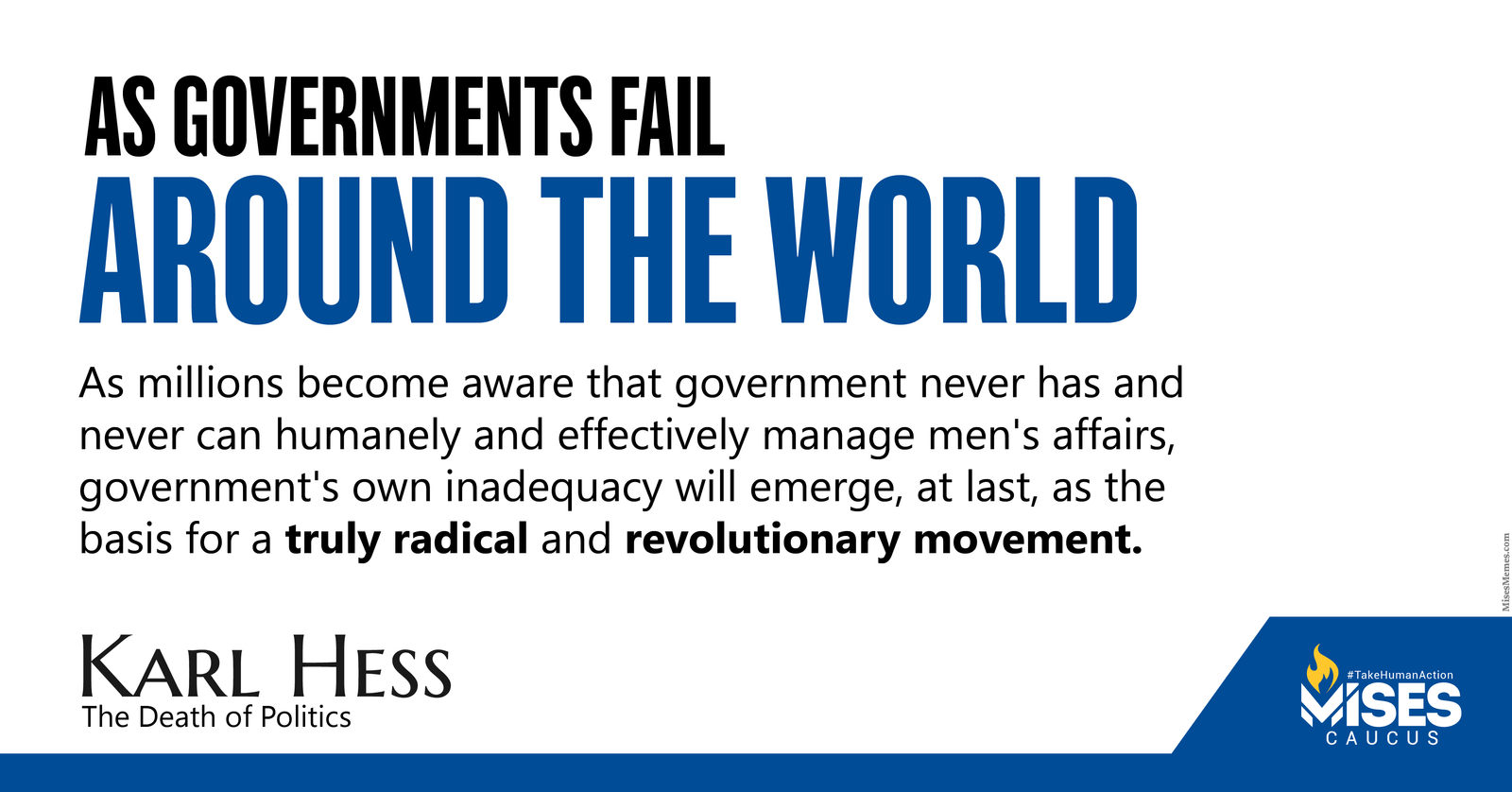
As governments fail around the world, as more millions become aware that government never has and never can humanely and effectively manage men's affairs, government's own inadequacy will emerge, at last, as the basis for a truly radical and revolutionary movement. —Karl Hess
Normal Quality (3840×2010 102 KB)
As governments fail around the world, as more millions become aware that government never has and never can humanely and effectively manage men's affairs, government's own inadequacy will emerge, at last, as the basis for a truly radical and revolutionary movement. —Karl Hess
Normal Quality (3840×3840 132 KB)
As governments fail around the world, as more millions become aware that government never has and never can humanely and effectively manage men's affairs, government's own inadequacy will emerge, at last, as the basis for a truly radical and revolutionary movement. —Karl Hess

As governments fail around the world, as more millions become aware that government never has and never can humanely and effectively manage men’s affairs, government’s own inadequacy will emerge, at last, as the basis for a truly radical and revolutionary movement. —Karl Hess

1305: Jeff Deist – A Position of Humility

Because we all see the world differently, we don't know what's best for everyone. That is precisely why we are libertarians. We start from a position of humility, not hubris. —Jeff Deist
Normal Quality (3840×2010 80 KB)
Because we all see the world differently, we don't know what's best for everyone. That is precisely why we are libertarians. We start from a position of humility, not hubris. —Jeff Deist
Normal Quality (3840×3840 111 KB)
Because we all see the world differently, we don't know what's best for everyone. That is precisely why we are libertarians. We start from a position of humility, not hubris. —Jeff Deist

Because we all see the world differently, we don’t know what’s best for everyone. That is precisely why we are libertarians. We start from a position of humility, not hubris. —Jeff Deist

1301: Tom Woods – Greatest Gains Against Poverty

The greatest gains against poverty in the United States occurred when government was least involved. —Tom Woods
Normal Quality (1920×1005 214 KB)
The greatest gains against poverty in the United States occurred when government was least involved. —Tom Woods
Normal Quality (1920×1372 277 KB)
The greatest gains against poverty in the United States occurred when government was least involved. —Tom Woods

The greatest gains against poverty in the United States occurred when government was least involved. —Tom Woods

1295: Ayn Rand – Businessmen vs. Bureaucrats

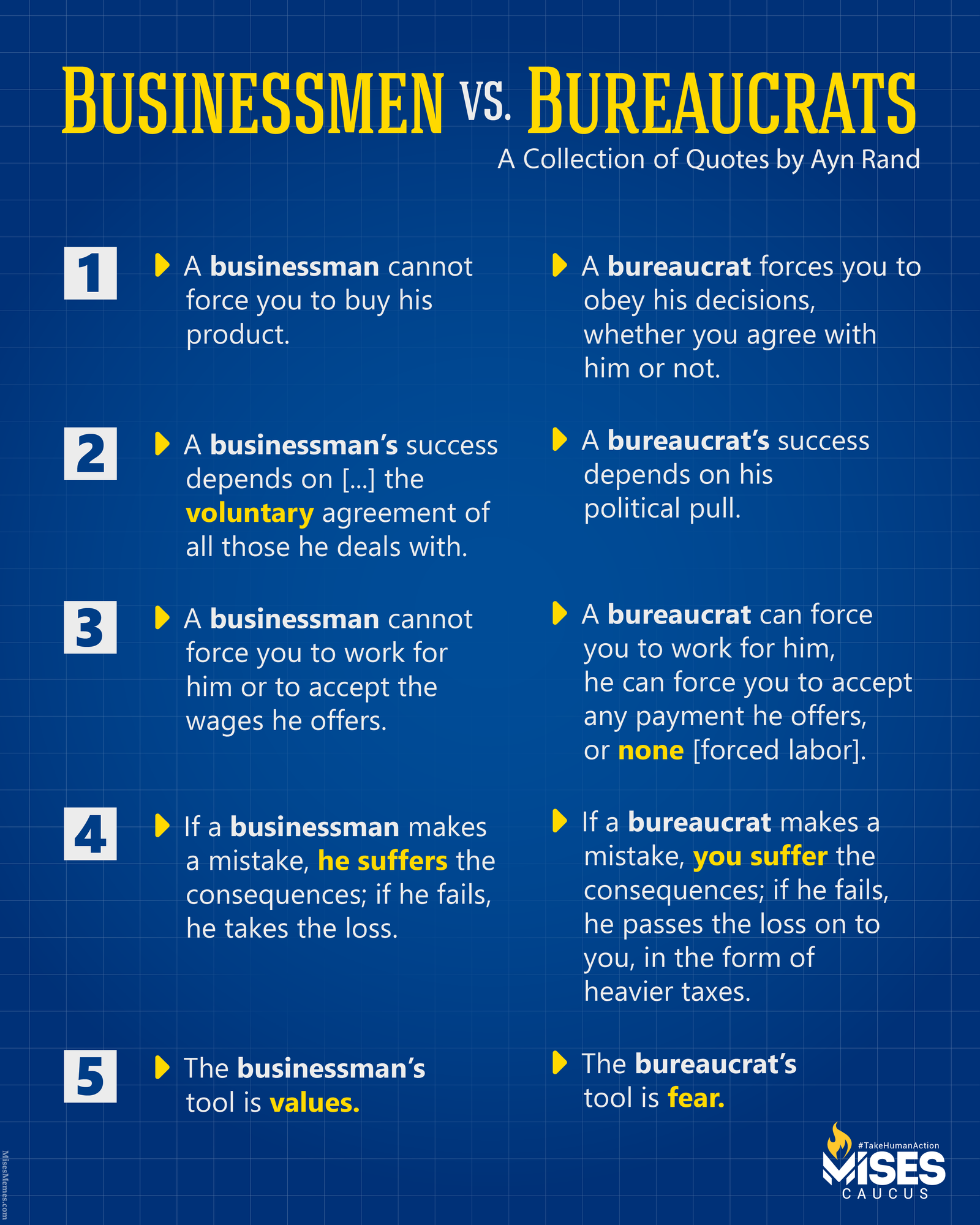
A businessman’s success depends on his intelligence, his knowledge, his productive ability, his economic judgment—and on the voluntary agreement of all those he deals with: his customers, his suppliers, his employees, his creditors or investors. A bureaucrat’s success depends on his political pull. A businessman cannot force you to buy his product; if he makes a mistake, he suffers the consequences; if he fails, he takes the loss. A bureaucrat forces you to obey his decisions, whether you agree with him or not—and the more advanced the stage of a country’s statism, the wider and more discretionary the powers wielded by a bureaucrat. If he makes a mistake, you suffer the consequences; if he fails, he passes the loss on to you, in the form of heavier taxes. —Ayn Rand
Normal Quality (3072×3840 755 KB)
A businessman’s success depends on his intelligence, his knowledge, his productive ability, his economic judgment—and on the voluntary agreement of all those he deals with: his customers, his suppliers, his employees, his creditors or investors. A bureaucrat’s success depends on his political pull. A businessman cannot force you to buy his product; if he makes a mistake, he suffers the consequences; if he fails, he takes the loss. A bureaucrat forces you to obey his decisions, whether you agree with him or not—and the more advanced the stage of a country’s statism, the wider and more discretionary the powers wielded by a bureaucrat. If he makes a mistake, you suffer the consequences; if he fails, he passes the loss on to you, in the form of heavier taxes. —Ayn Rand
Normal Quality (3072×3840 786 KB)

A businessman’s success depends on his intelligence, his knowledge, his productive ability, his economic judgment—and on the voluntary agreement of all those he deals with: his customers, his suppliers, his employees, his creditors or investors. A bureaucrat’s success depends on his political pull. A businessman cannot force you to buy his product; if he makes a mistake, he suffers the consequences; if he fails, he takes the loss. A bureaucrat forces you to obey his decisions, whether you agree with him or not—and the more advanced the stage of a country’s statism, the wider and more discretionary the powers wielded by a bureaucrat. If he makes a mistake, you suffer the consequences; if he fails, he passes the loss on to you, in the form of heavier taxes.

A businessman cannot force you to work for him or to accept the wages he offers; you are free to seek employment elsewhere and to accept a better offer, if you can find it. (Remember, in this context, that jobs do not exist “in nature,” that they do not grow on trees, that someone has to create the job you need, and that that someone, the businessman, will go out of business if he pays you more than the market permits him to pay you.) A bureaucrat can force you to work for him, when he achieves the totalitarian power he seeks; he can force you to accept any payment he offers—or none, as witness the forced labor camps in the countries of full statism.

The businessman’s tool is values; the bureaucrat’s tool is fear.

—Ayn Rand
1293: Ludwig von Mises – What Capitalism Gave the World

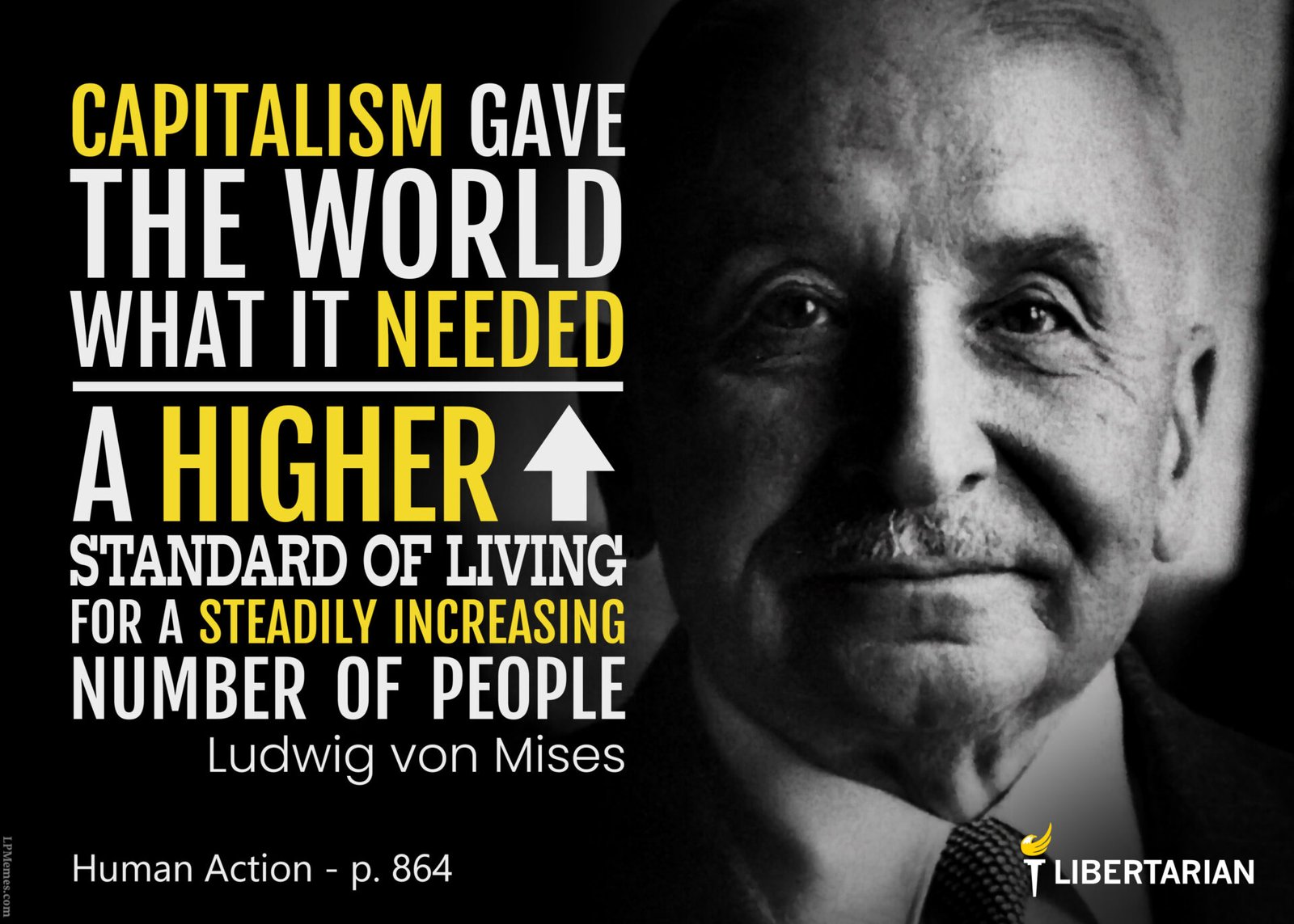
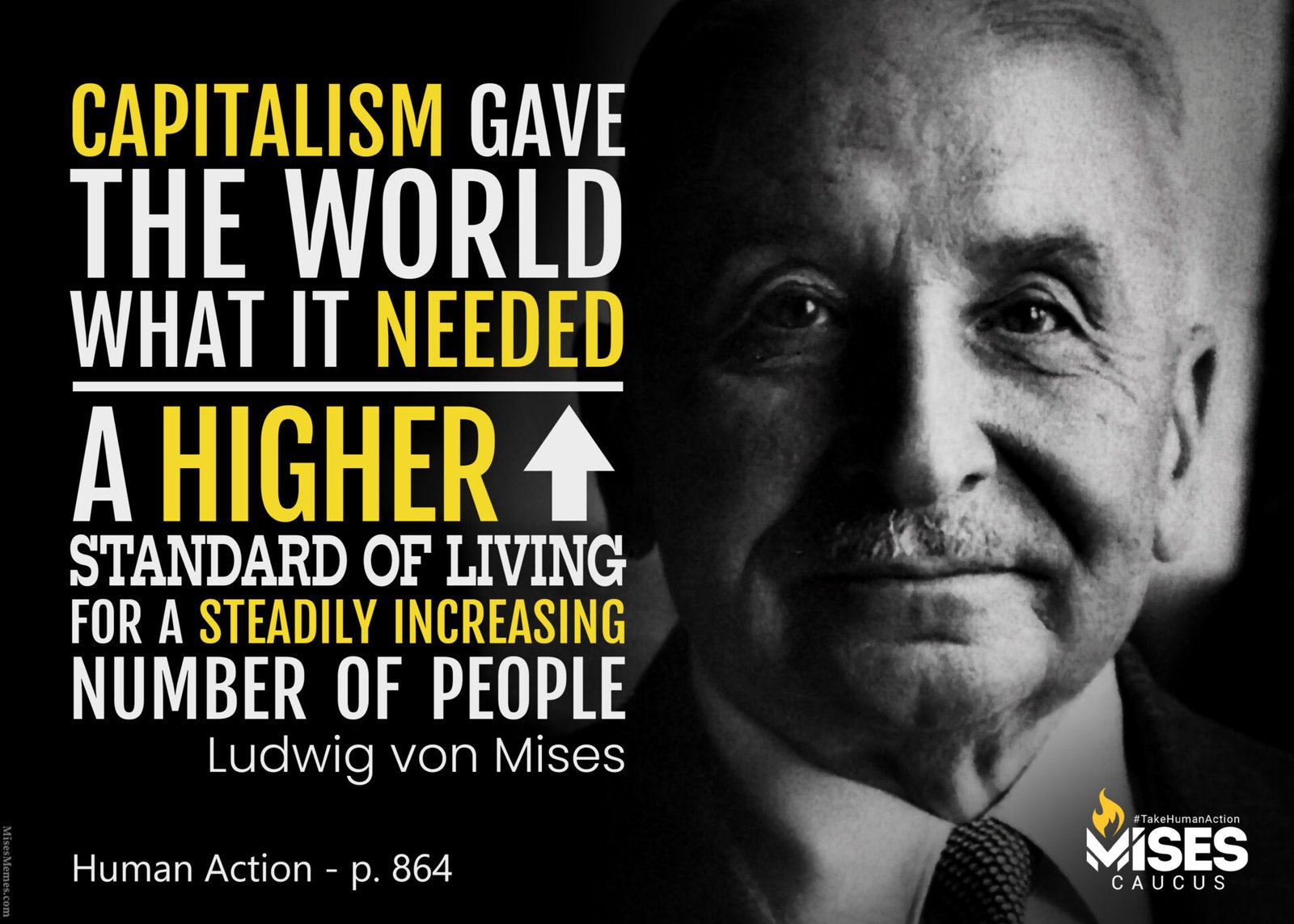
Capitalism gave the world what it needed, a higher standard of living for a steadily increasing number of people. —Ludwig von Mises
Normal Quality (1920×1005 200 KB)
Capitalism gave the world what it needed, a higher standard of living for a steadily increasing number of people. —Ludwig von Mises
Normal Quality (1920×1372 264 KB)
Capitalism gave the world what it needed, a higher standard
of living for a steadily increasing number of people. —Ludwig von Mises
Capitalism gave the world what it needed, a higher standard
of living for a steadily increasing number of people. —Ludwig von Mises

Capitalism gave the world what it needed, a higher standard
of living for a steadily increasing number of people. —Ludwig von Mises

1292: Frederic Bastiat – The Socialists

We disapprove of state education. Then the socialists say that we are opposed to any education. We object to a state religion. Then the socialists say that we want no religion at all. We object to a state-enforced equality. Then they say that we are against equality. And so on, and so on. It is as if the socialists were to accuse us of not wanting persons to eat because we do not want the state to raise grain. —Frederic Bastiat
Normal Quality (2770×3840 758 KB)

We disapprove of state education. Then the socialists say that we are opposed to any education. We object to a state religion. Then the socialists say that we want no religion at all. We object to a state-enforced equality. Then they say that we are against equality. And so on, and so on. It is as if the socialists were to accuse us of not wanting persons to eat because we do not want the state to raise grain. —Frederic Bastiat

1288: Henry Hazlitt – Maximize Production to Cure Poverty

The only real cure for poverty is production. The way to maximize production is to maximize the incentives to production. —Henry Hazlitt
Normal Quality (1920×1005 378 KB)
The only real cure for poverty is production. The way to maximize production is to maximize the incentives to production. —Henry Hazlitt
Normal Quality (1920×1372 510 KB)
The only real cure for poverty is production. The way to maximize production is to maximize the incentives to production. —Henry Hazlitt

The only real cure for poverty is production. The way to maximize production is to maximize the incentives to production. —Henry Hazlitt

1284: Henry George – What Protectionism Teaches Us

What protectionism teaches us is to do to ourselves in times of peace what enemies seek to do to us in time of war. —Henry George
Normal Quality (1920×1005 193 KB)
What protectionism teaches us is to do to ourselves in times of peace what enemies seek to do to us in time of war. —Henry George
Normal Quality (1920×1372 222 KB)
What protectionism teaches us is to do to ourselves in times of peace what enemies seek to do to us in time of war. —Henry George

What protectionism teaches us is to do to ourselves in times of peace what enemies seek to do to us in time of war. —Henry George

1273: Walter Block – Libertarianism is Neither Left nor Right

Libertarianism is neither of the left nor of the right. It is unique. It is sui generis. It is apart from left and right. The left-right political spectrum simply has no room for libertarianism. Think of an equilateral triangle, with libertarianism at one corner, the left at a second corner and the right at the third corner. We are equally distant from both of those misbegotten political economic philosophies. No, better yet, think in terms of an isosceles triangle, with us at the top and the two of them at the bottom, indicating they have more in common with each other than with us. —Walter Block
Normal Quality (3840×2010 555 KB)
Libertarianism is neither of the left nor of the right. It is unique. It is sui generis. It is apart from left and right. The left-right political spectrum simply has no room for libertarianism. Think of an equilateral triangle, with libertarianism at one corner, the left at a second corner and the right at the third corner. We are equally distant from both of those misbegotten political economic philosophies. No, better yet, think in terms of an isosceles triangle, with us at the top and the two of them at the bottom, indicating they have more in common with each other than with us. —Walter Block
Normal Quality (3072×3840 738 KB)
Libertarianism is neither of the left nor of the right. It is unique. It is sui generis. It is apart from left and right. The left-right political spectrum simply has no room for libertarianism. Think of an equilateral triangle, with libertarianism at one corner, the left at a second corner and the right at the third corner. We are equally distant from both of those misbegotten political economic philosophies. No, better yet, think in terms of an isosceles triangle, with us at the top and the two of them at the bottom, indicating they have more in common with each other than with us. —Walter Block

Libertarianism is neither of the left nor of the right. It is unique. It is sui generis. It is apart from left and right. The left-right political spectrum simply has no room for libertarianism. Think of an equilateral triangle, with libertarianism at one corner, the left at a second corner and the right at the third corner. We are equally distant from both of those misbegotten political economic philosophies. No, better yet, think in terms of an isosceles triangle, with us at the top and the two of them at the bottom, indicating they have more in common with each other than with us. —Walter Block