1449: Thomas Massie – Big Government vs. Big Business

The big difference between big government and big business is big government can take you to jail, or shoot you if you don't comply. —Thomas Massie
Normal Quality (1920×1005 204 KB)
The big difference between big government and big business is big government can take you to jail, or shoot you if you don't comply. —Thomas Massie
Normal Quality (1920×1372 276 KB)
The big difference between big government and big business is big government can take you to jail, or shoot you if you don't comply. —Thomas Massie

The big difference between big government and big business is big government can take you to jail, or shoot you if you don’t comply. —Thomas Massie

1446: Ayn Rand – If Capitalism Never Existed

If capitalism had never existed, any honest humanitarian should have been struggling to invent it. But when you see men struggling to evade its existence, to misrepresent its nature, and to destroy its last remnants—you may be sure that whatever their motives, love for man is not one of them. —Ayn Rand
Normal Quality (1920×1005 192 KB)
If capitalism had never existed, any honest humanitarian should have been struggling to invent it. But when you see men struggling to evade its existence, to misrepresent its nature, and to destroy its last remnants—you may be sure that whatever their motives, love for man is not one of them. —Ayn Rand
Normal Quality (1920×1372 236 KB)
If capitalism had never existed, any honest humanitarian should have been struggling to invent it. But when you see men struggling to evade its existence, to misrepresent its nature, and to destroy its last remnants—you may be sure that whatever their motives, love for man is not one of them. —Ayn Rand

If capitalism had never existed, any honest humanitarian should have been struggling to invent it. But when you see men struggling to evade its existence, to misrepresent its nature, and to destroy its last remnants—you may be sure that whatever their motives, love for man is not one of them. —Ayn Rand

1337: Ayn Rand – The Right to Enslave

If some men are entitled by right to the products of the work of others, it means that those others are deprived of rights and condemned to slave labor. No man can have a right to impose an unchosen obligation, an unrewarded duty, or an involuntary servitude on another man. There can be no such thing as “the right to enslave” —Ayn Rand
Normal Quality (3840×2010 90 KB)
If some men are entitled by right to the products of the work of others, it means that those others are deprived of rights and condemned to slave labor. No man can have a right to impose an unchosen obligation, an unrewarded duty, or an involuntary servitude on another man. There can be no such thing as “the right to enslave” —Ayn Rand
Normal Quality (3840×3840 249 KB)
If some men are entitled by right to the products of the work of others, it means that those others are deprived of rights and condemned to slave labor. No man can have a right to impose an unchosen obligation, an unrewarded duty, or an involuntary servitude on another man. There can be no such thing as “the right to enslave” —Ayn Rand

If some men are entitled by right to the products of the work of others, it means that those others are deprived of rights and condemned to slave labor. No man can have a right to impose an unchosen obligation, an unrewarded duty, or an involuntary servitude on another man. There can be no such thing as “the right to enslave” —Ayn Rand

1333: Ludwig von Mises – Socialism Breeds Inequality

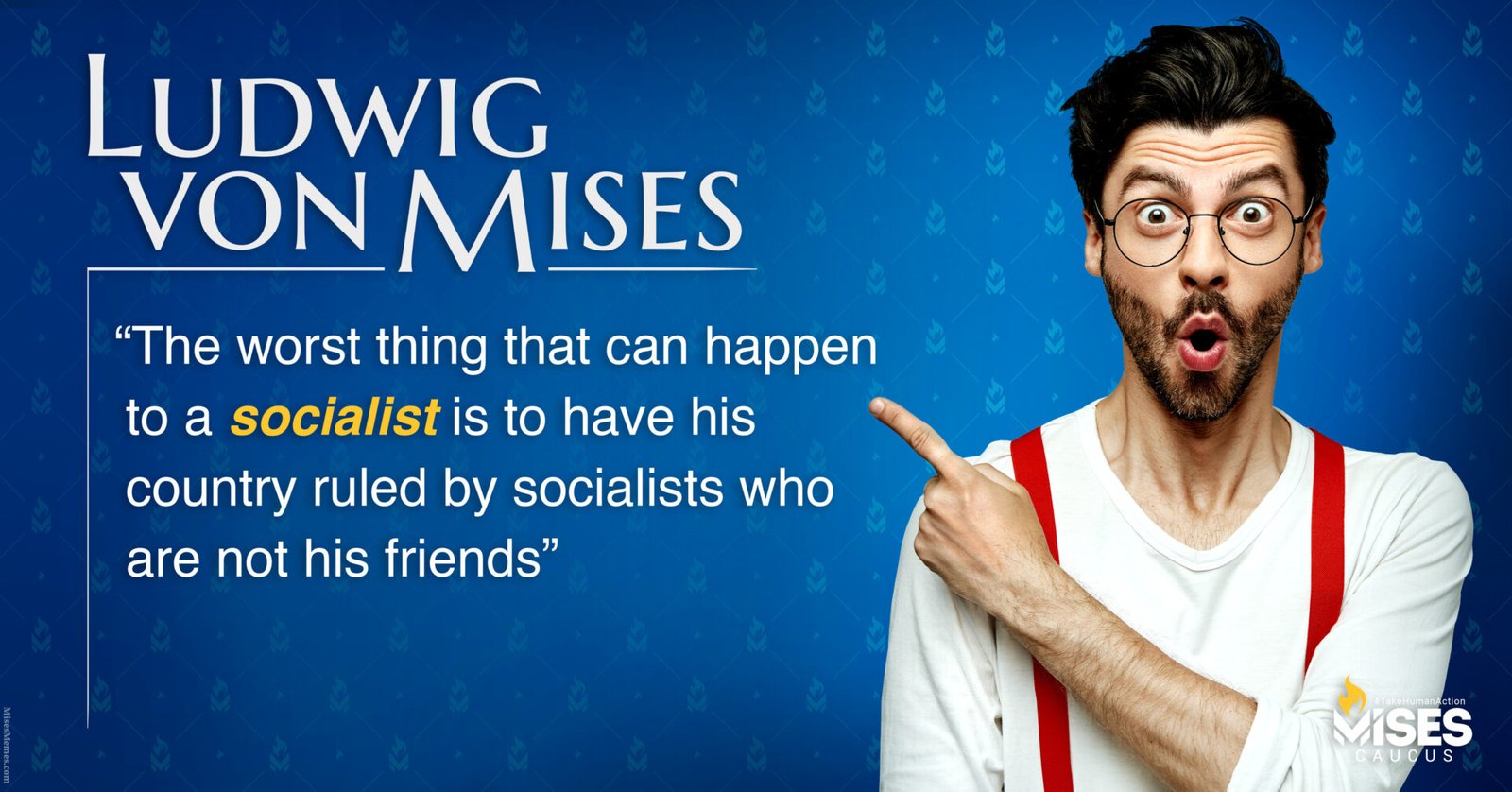
The worst thing that can happen to a socialist is to have his country ruled by socialists who are not his friends. —Ludwig von Mises
Normal Quality (1920×1005 157 KB)
The worst thing that can happen to a socialist is to have his country ruled by socialists who are not his friends. —Ludwig von Mises
Normal Quality (1920×1372 225 KB)
The worst thing that can happen to a socialist is to have his country ruled by socialists who are not his friends. —Ludwig von Mises

The worst thing that can happen to a socialist is to have his country ruled by socialists who are not his friends. —Ludwig von Mises

1332: Ludwig von Mises – Hypocrisy of Anti-Capitalists

All people, however fanatical they may be in their zeal to disparage and to fight capitalism, implicitly pay homage to it by passionately clamoring for the products it turns out. —Ludwig von Mises
Normal Quality (1920×1005 172 KB)
All people, however fanatical they may be in their zeal to disparage and to fight capitalism, implicitly pay homage to it by passionately clamoring for the products it turns out. —Ludwig von Mises
Normal Quality (1920×1372 220 KB)
All people, however fanatical they may be in their zeal to disparage and to fight capitalism, implicitly pay homage to it by passionately clamoring for the products it turns out. —Ludwig von Mises

All people, however fanatical they may be in their zeal to disparage and to fight capitalism, implicitly pay homage to it by passionately clamoring for the products it turns out. —Ludwig von Mises

1322: Gloria Alvarez – You Cannot Admire Dictators

If you are up for life, if you defend life, you cannot admire murderers. If you are up for defending private property, you cannot admire thieves. If you are up for liberty you cannot admire dictators. —Gloria Alvarez
Normal Quality (3072×3840 159 KB)

If you are up for life, if you defend life, you cannot admire murderers. If you are up for defending private property, you cannot admire thieves. If you are up for liberty you cannot admire dictators. —Gloria Alvarez

1292: Frederic Bastiat – The Socialists

We disapprove of state education. Then the socialists say that we are opposed to any education. We object to a state religion. Then the socialists say that we want no religion at all. We object to a state-enforced equality. Then they say that we are against equality. And so on, and so on. It is as if the socialists were to accuse us of not wanting persons to eat because we do not want the state to raise grain. —Frederic Bastiat
Normal Quality (2770×3840 758 KB)

We disapprove of state education. Then the socialists say that we are opposed to any education. We object to a state religion. Then the socialists say that we want no religion at all. We object to a state-enforced equality. Then they say that we are against equality. And so on, and so on. It is as if the socialists were to accuse us of not wanting persons to eat because we do not want the state to raise grain. —Frederic Bastiat

1281: Henry Hazlitt – Government-Provided Free Tuition

Government-provided free tuition tends more and more to produce a uniform conformist education, with college faculties ultimately dependent for their jobs on the government, and so developing an economic interest in the profession and teaching a statist, pro-government, and socialist ideology. —Henry Hazlitt
Normal Quality (1920×1005 198 KB)
Government-provided free tuition tends more and more to produce a uniform conformist education, with college faculties ultimately dependent for their jobs on the government, and so developing an economic interest in the profession and teaching a statist, pro-government, and socialist ideology. —Henry Hazlitt
Normal Quality (1920×1372 246 KB)
Government-provided free tuition tends more and more to produce a uniform conformist education, with college faculties ultimately dependent for their jobs on the government, and so developing an economic interest in the profession and teaching a statist, pro-government, and socialist ideology. —Henry Hazlitt

Government-provided free tuition tends more and more to produce a uniform conformist education, with college faculties ultimately dependent for their jobs on the government, and so developing an economic interest in the profession and teaching a statist, pro-government, and socialist ideology. —Henry Hazlitt

1267: Walter Williams – The Poor are Getting Richer

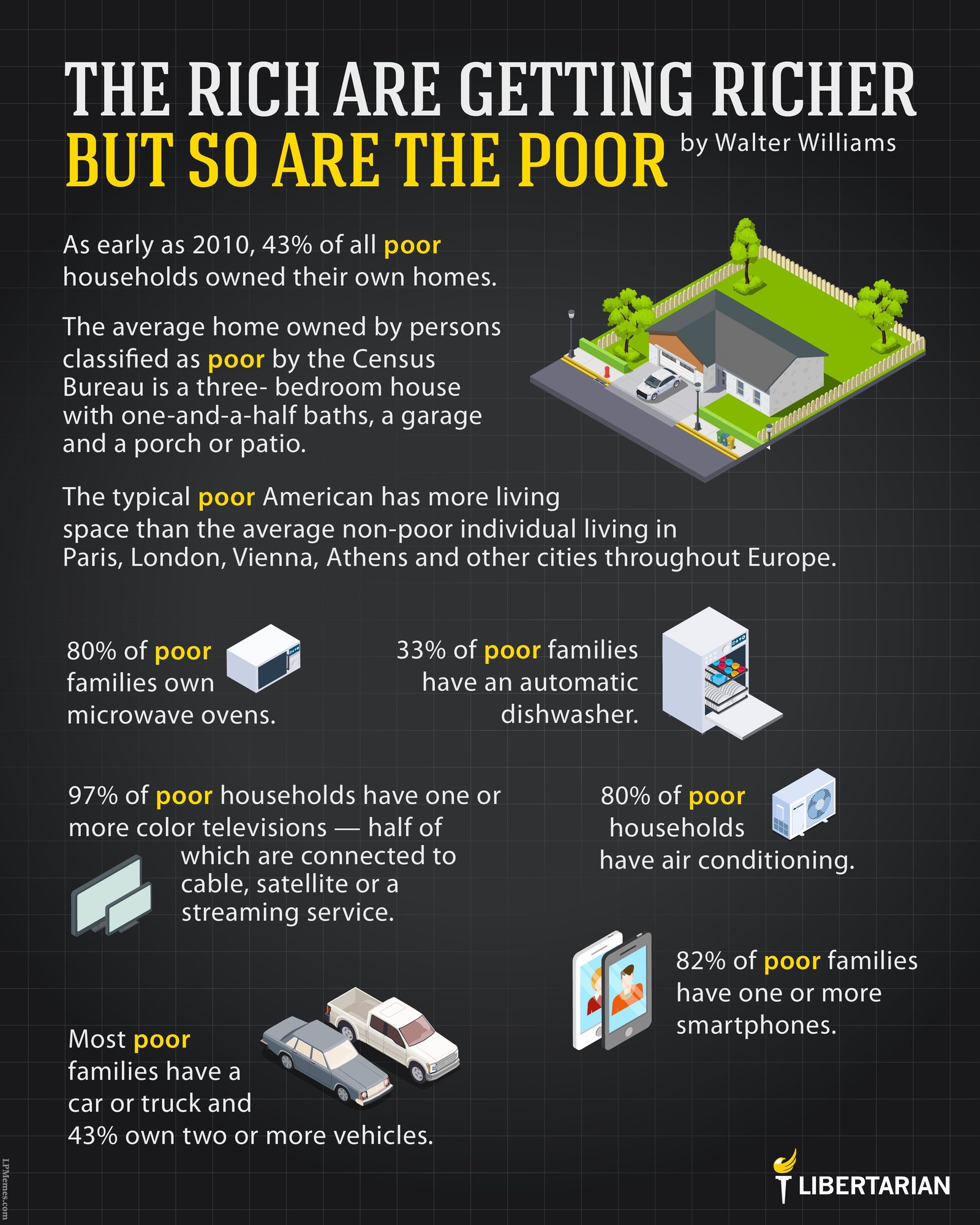
As early as 2010, 43% of all poor households owned their own homes. The average home owned by persons classified as poor by the Census Bureau is a three-bedroom house with one-and-a-half baths, a garage and a porch or patio. Eighty percent of poor households have air conditioning. The typical poor American has more living space than the average non-poor individual living in Paris, London, Vienna, Athens and other cities throughout Europe. Ninety-seven percent of poor households have one or more color televisions — half of which are connected to cable, satellite or a streaming service. Some 82% of poor families have one or more smartphones. Eighty-nine percent own microwave ovens and more than a third have an automatic dishwasher. Most poor families have a car or truck and 43% own two or more vehicles. —Walter Williams
Normal Quality (1920×1005 277 KB)
As early as 2010, 43% of all poor households owned their own homes. The average home owned by persons classified as poor by the Census Bureau is a three-bedroom house with one-and-a-half baths, a garage and a porch or patio. Eighty percent of poor households have air conditioning. The typical poor American has more living space than the average non-poor individual living in Paris, London, Vienna, Athens and other cities throughout Europe. Ninety-seven percent of poor households have one or more color televisions — half of which are connected to cable, satellite or a streaming service. Some 82% of poor families have one or more smartphones. Eighty-nine percent own microwave ovens and more than a third have an automatic dishwasher. Most poor families have a car or truck and 43% own two or more vehicles. —Walter Williams
Normal Quality (3072×3840 855 KB)
As early as 2010, 43% of all poor households owned their own homes. The average home owned by persons classified as poor by the Census Bureau is a three-bedroom house with one-and-a-half baths, a garage and a porch or patio. Eighty percent of poor households have air conditioning. The typical poor American has more living space than the average non-poor individual living in Paris, London, Vienna, Athens and other cities throughout Europe. Ninety-seven percent of poor households have one or more color televisions — half of which are connected to cable, satellite or a streaming service. Some 82% of poor families have one or more smartphones. Eighty-nine percent own microwave ovens and more than a third have an automatic dishwasher. Most poor families have a car or truck and 43% own two or more vehicles. —Walter Williams

As early as 2010, 43% of all poor households owned their own homes. The average home owned by persons classified as poor by the Census Bureau is a three-bedroom house with one-and-a-half baths, a garage and a porch or patio. Eighty percent of poor households have air conditioning. The typical poor American has more living space than the average non-poor individual living in Paris, London, Vienna, Athens and other cities throughout Europe. Ninety-seven percent of poor households have one or more color televisions — half of which are connected to cable, satellite or a streaming service. Some 82% of poor families have one or more smartphones. Eighty-nine percent own microwave ovens and more than a third have an automatic dishwasher. Most poor families have a car or truck and 43% own two or more vehicles. —Walter Williams

1245: Murray Rothbard – The State is Inherently Anti-Capitalist

Since the State necessarily lives by the compulsory confiscation of private capital, and since its expansion necessarily involves ever-greater incursions on private individuals and private enterprise, we must assert that the State is profoundly and inherently anti-capitalist. —Murray Rothbard
Normal Quality (3840×2010 278 KB)
Since the State necessarily lives by the compulsory confiscation of private capital, and since its expansion necessarily involves ever-greater incursions on private individuals and private enterprise, we must assert that the State is profoundly and inherently anti-capitalist. —Murray Rothbard
Normal Quality (1730×1920 213 KB)

Since the State necessarily lives by the compulsory confiscation of private capital, and since its expansion necessarily involves ever-greater incursions on private individuals and private enterprise, we must assert that the State is profoundly and inherently anti-capitalist. —Murray Rothbard