1304: Henry Hazlitt – The Neglect of Thinking

Every man knows there are evils in the world which need setting right… to most men one in particular stands out vividly… it stands out with such startling vividness that they lose sight of other evils. To the Socialist this evil is the capitalistic system; to the feminist, it is the subjection of women; to the clergyman, it is the decline of religion; to the staunch Republican it is the Democratic Party, and so on, ad infinitum. I, too, have a pet little evil, to which I am apt to attribute all the others. This evil is the neglect of thinking. And when I say thinking I mean real thinking, independent thinking, hard thinking. —Henry Hazlitt
Normal Quality (3007×3840 646 KB)

Every man knows there are evils in the world which need setting right… to most men one in particular stands out vividly… it stands out with such startling vividness that they lose sight of other evils. To the Socialist this evil is the capitalistic system; to the feminist, it is the subjection of women; to the clergyman, it is the decline of religion; to the staunch Republican it is the Democratic Party, and so on, ad infinitum. I, too, have a pet little evil, to which I am apt to attribute all the others. This evil is the neglect of thinking. And when I say thinking I mean real thinking, independent thinking, hard thinking. —Henry Hazlitt

1301: Tom Woods – Greatest Gains Against Poverty

The greatest gains against poverty in the United States occurred when government was least involved. —Tom Woods
Normal Quality (1920×1005 214 KB)
The greatest gains against poverty in the United States occurred when government was least involved. —Tom Woods
Normal Quality (1920×1372 277 KB)
The greatest gains against poverty in the United States occurred when government was least involved. —Tom Woods

The greatest gains against poverty in the United States occurred when government was least involved. —Tom Woods

1296: Walter Williams – False Charity

The act of reaching into one’s own pockets to help a fellow man in need is praiseworthy and laudable. Reaching into someone else’s pocket is despicable. —Walter Williams
Normal Quality (1920×1005 272 KB)
The act of reaching into one’s own pockets to help a fellow man in need is praiseworthy and laudable. Reaching into someone else’s pocket is despicable. —Walter Williams
Normal Quality (1920×1372 367 KB)
The act of reaching into one’s own pockets to help a fellow man in need is praiseworthy and laudable. Reaching into someone else’s pocket is despicable. —Walter Williams

The act of reaching into one’s own pockets to help a fellow man in need is praiseworthy and laudable. Reaching into someone else’s pocket is despicable. —Walter Williams

1295: Ayn Rand – Businessmen vs. Bureaucrats

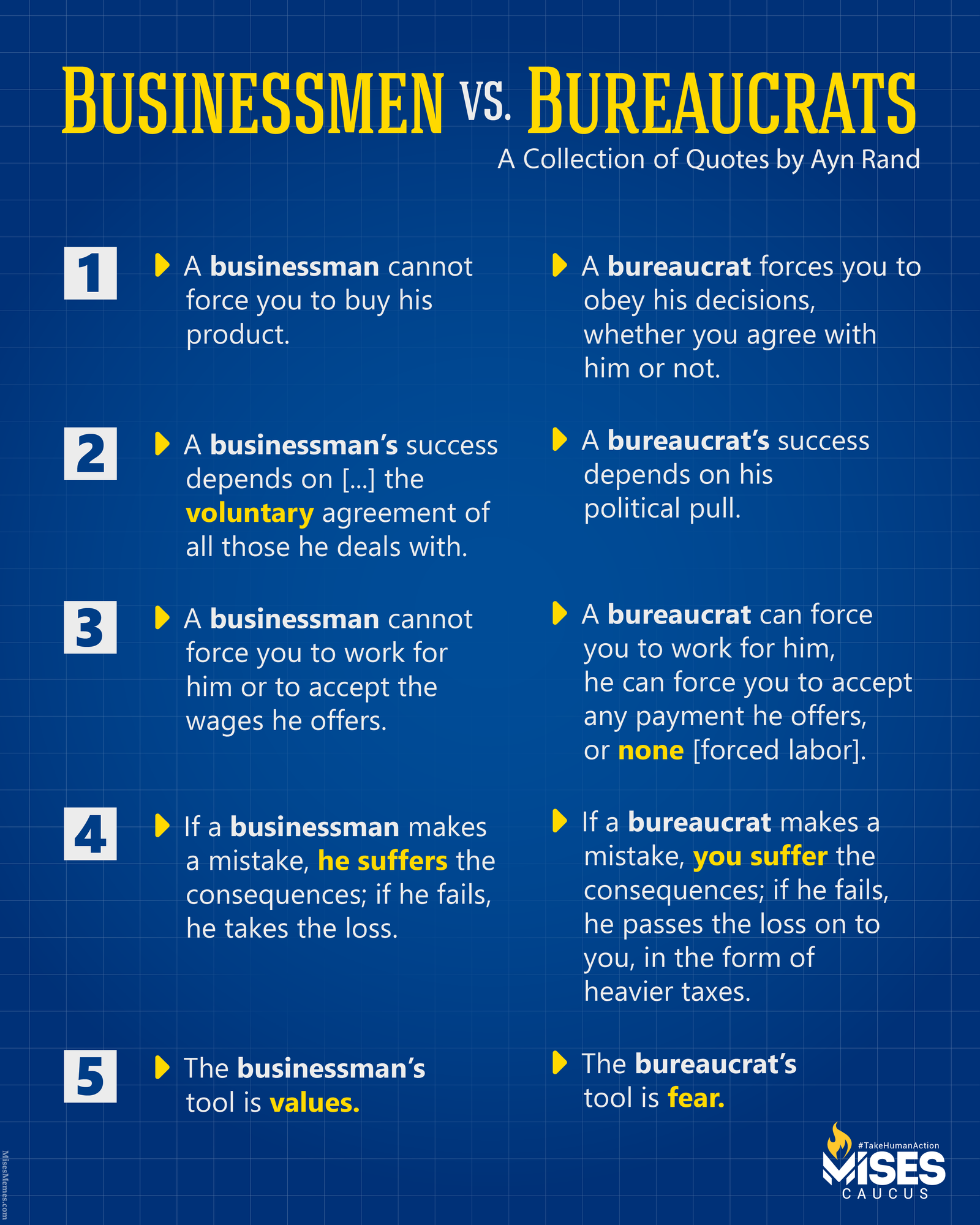
A businessman’s success depends on his intelligence, his knowledge, his productive ability, his economic judgment—and on the voluntary agreement of all those he deals with: his customers, his suppliers, his employees, his creditors or investors. A bureaucrat’s success depends on his political pull. A businessman cannot force you to buy his product; if he makes a mistake, he suffers the consequences; if he fails, he takes the loss. A bureaucrat forces you to obey his decisions, whether you agree with him or not—and the more advanced the stage of a country’s statism, the wider and more discretionary the powers wielded by a bureaucrat. If he makes a mistake, you suffer the consequences; if he fails, he passes the loss on to you, in the form of heavier taxes. —Ayn Rand
Normal Quality (3072×3840 755 KB)
A businessman’s success depends on his intelligence, his knowledge, his productive ability, his economic judgment—and on the voluntary agreement of all those he deals with: his customers, his suppliers, his employees, his creditors or investors. A bureaucrat’s success depends on his political pull. A businessman cannot force you to buy his product; if he makes a mistake, he suffers the consequences; if he fails, he takes the loss. A bureaucrat forces you to obey his decisions, whether you agree with him or not—and the more advanced the stage of a country’s statism, the wider and more discretionary the powers wielded by a bureaucrat. If he makes a mistake, you suffer the consequences; if he fails, he passes the loss on to you, in the form of heavier taxes. —Ayn Rand
Normal Quality (3072×3840 786 KB)

A businessman’s success depends on his intelligence, his knowledge, his productive ability, his economic judgment—and on the voluntary agreement of all those he deals with: his customers, his suppliers, his employees, his creditors or investors. A bureaucrat’s success depends on his political pull. A businessman cannot force you to buy his product; if he makes a mistake, he suffers the consequences; if he fails, he takes the loss. A bureaucrat forces you to obey his decisions, whether you agree with him or not—and the more advanced the stage of a country’s statism, the wider and more discretionary the powers wielded by a bureaucrat. If he makes a mistake, you suffer the consequences; if he fails, he passes the loss on to you, in the form of heavier taxes.

A businessman cannot force you to work for him or to accept the wages he offers; you are free to seek employment elsewhere and to accept a better offer, if you can find it. (Remember, in this context, that jobs do not exist “in nature,” that they do not grow on trees, that someone has to create the job you need, and that that someone, the businessman, will go out of business if he pays you more than the market permits him to pay you.) A bureaucrat can force you to work for him, when he achieves the totalitarian power he seeks; he can force you to accept any payment he offers—or none, as witness the forced labor camps in the countries of full statism.

The businessman’s tool is values; the bureaucrat’s tool is fear.

—Ayn Rand

1292: Frederic Bastiat – The Socialists

We disapprove of state education. Then the socialists say that we are opposed to any education. We object to a state religion. Then the socialists say that we want no religion at all. We object to a state-enforced equality. Then they say that we are against equality. And so on, and so on. It is as if the socialists were to accuse us of not wanting persons to eat because we do not want the state to raise grain. —Frederic Bastiat
Normal Quality (2770×3840 758 KB)

We disapprove of state education. Then the socialists say that we are opposed to any education. We object to a state religion. Then the socialists say that we want no religion at all. We object to a state-enforced equality. Then they say that we are against equality. And so on, and so on. It is as if the socialists were to accuse us of not wanting persons to eat because we do not want the state to raise grain. —Frederic Bastiat

1285: Lysander Spooner – If Money Can Be Taken by Government

If any man's money can be taken by a so-called government, without his own personal consent, all his other rights are taken with it; for with his money the government can, and will, hire soldiers to stand over him, compel him to submit to its arbitrary will, and kill him if he resists. —Lysander Spooner
Normal Quality (1920×1005 208 KB)
If any man's money can be taken by a so-called government, without his own personal consent, all his other rights are taken with it; for with his money the government can, and will, hire soldiers to stand over him, compel him to submit to its arbitrary will, and kill him if he resists. —Lysander Spooner
Normal Quality (1920×1372 252 KB)
If any man's money can be taken by a so-called government, without his own personal consent, all his other rights are taken with it; for with his money the government can, and will, hire soldiers to stand over him, compel him to submit to its arbitrary will, and kill him if he resists. —Lysander Spooner

If any man’s money can be taken by a so-called government, without his own personal consent, all his other rights are taken with it; for with his money the government can, and will, hire soldiers to stand over him, compel him to submit to its arbitrary will, and kill him if he resists. —Lysander Spooner

1281: Henry Hazlitt – Government-Provided Free Tuition

Government-provided free tuition tends more and more to produce a uniform conformist education, with college faculties ultimately dependent for their jobs on the government, and so developing an economic interest in the profession and teaching a statist, pro-government, and socialist ideology. —Henry Hazlitt
Normal Quality (1920×1005 198 KB)
Government-provided free tuition tends more and more to produce a uniform conformist education, with college faculties ultimately dependent for their jobs on the government, and so developing an economic interest in the profession and teaching a statist, pro-government, and socialist ideology. —Henry Hazlitt
Normal Quality (1920×1372 246 KB)
Government-provided free tuition tends more and more to produce a uniform conformist education, with college faculties ultimately dependent for their jobs on the government, and so developing an economic interest in the profession and teaching a statist, pro-government, and socialist ideology. —Henry Hazlitt

Government-provided free tuition tends more and more to produce a uniform conformist education, with college faculties ultimately dependent for their jobs on the government, and so developing an economic interest in the profession and teaching a statist, pro-government, and socialist ideology. —Henry Hazlitt

1280: Henry Hazlitt: The Gospel of Marxism

The whole gospel of Karl Marx can be summed up in a single sentence: Hate the man who is better off than you are. Never under any circumstances admit that his success may be due to his own efforts, to the productive contribution he has made to the whole community. Always attribute his success to the exploitation, the cheating, the more or less open robbery of others. Never under any circumstances admit that your own failure may be owing to your own weakness, or that the failure of anyone else may be due to his own defects — his laziness, incompetence, improvidence or stupidity. Never believe in the honesty or disinterestedness of anyone who disagrees with you. This basic hatred is the heart of Marxism. This is its animating force. You can throw away the dialectical materialism, the Hegelian framework, the technical jargon, the “scientific” analysis, and millions of pretentious words, and you still have the core: the implacable hatred and envy that are the raison d’etre for all the rest. — Henry Hazlitt
Normal Quality (3072×3840 863 KB)
The whole gospel of Karl Marx can be summed up in a single sentence: Hate the man who is better off than you are. Never under any circumstances admit that his success may be due to his own efforts, to the productive contribution he has made to the whole community. Always attribute his success to the exploitation, the cheating, the more or less open robbery of others.

Never under any circumstances admit that your own failure may be owing to your own weakness, or that the failure of anyone else may be due to his own defects — his laziness, incompetence, improvidence or stupidity. Never believe in the honesty or disinterestedness of anyone who disagrees with you.

This basic hatred is the heart of Marxism. This is its animating force. You can throw away the dialectical materialism, the Hegelian framework, the technical jargon, the “scientific” analysis, and millions of pretentious words, and you still have the core: the implacable hatred and envy that are the raison d’etre for all the rest.

— Henry Hazlitt
Normal Quality (3072×3840 844 KB)

The whole gospel of Karl Marx can be summed up in a single sentence: Hate the man who is better off than you are. Never under any circumstances admit that his success may be due to his own efforts, to the productive contribution he has made to the whole community. Always attribute his success to the exploitation, the cheating, the more or less open robbery of others.

Never under any circumstances admit that your own failure may be owing to your own weakness, or that the failure of anyone else may be due to his own defects — his laziness, incompetence, improvidence or stupidity. Never believe in the honesty or disinterestedness of anyone who disagrees with you.

This basic hatred is the heart of Marxism. This is its animating force. You can throw away the dialectical materialism, the Hegelian framework, the technical jargon, the “scientific” analysis, and millions of pretentious words, and you still have the core: the implacable hatred and envy that are the raison d’etre for all the rest.

— Henry Hazlitt

1272: David Boaz – Libertarianism and Socialism

The difference between libertarianism and socialism is that libertarians will tolerate the existence of a socialist community, but socialists can’t tolerate a libertarian community. —David Boaz
Normal Quality (1920×1005 303 KB)
The difference between libertarianism and socialism is that libertarians will tolerate the existence of a socialist community, but socialists can’t tolerate a libertarian community. —David Boaz
Normal Quality (1920×1372 433 KB)
The difference between libertarianism and socialism is that libertarians will tolerate the existence of a socialist community, but socialists can’t tolerate a libertarian community. —David Boaz

The difference between libertarianism and socialism is that libertarians will tolerate the existence of a socialist community, but socialists can’t tolerate a libertarian community. —David Boaz

1264: Patrick Bet-David – Capitalism Reveals Everything

Capitalism reveals everything. It reveals who works. It reveals who improves. It reveals who takes care of their best employees and who doesn’t. It reveals who’s creative. It reveals who thinks the biggest. It reveals who doesn’t want to pull their own little red wagon instead they want you to pull it. —Patrick Bet-David
Normal Quality (1920×1005 207 KB)
Capitalism reveals everything. It reveals who works. It reveals who improves. It reveals who takes care of their best employees and who doesn’t. It reveals who’s creative. It reveals who thinks the biggest. It reveals who doesn’t want to pull their own little red wagon instead they want you to pull it. —Patrick Bet-David
Normal Quality (1920×1372 276 KB)
Capitalism reveals everything.
It reveals who works.
It reveals who improves.
It reveals who takes care of their best employees and who doesn’t.
It reveals who’s creative.
It reveals who thinks the biggest.
It reveals who doesn’t want to pull their own little red wagon instead they want you to pull it.
—Patrick Bet-David