1387: Jeff Deist – Withdrawal from the Federal Leviathan

Imagine what a committed, coordinated libertarian base could achieve in America! Ten percent of the US population, or roughly thirty-two million people, would be an unstoppable force of non-violent withdrawal from the federal leviathan. —Jeff Deist
Normal Quality (1920×1005 324 KB)
Imagine what a committed, coordinated libertarian base could achieve in America! Ten percent of the US population, or roughly thirty-two million people, would be an unstoppable force of non-violent withdrawal from the federal leviathan. —Jeff Deist
Normal Quality (1920×1372 410 KB)
Imagine what a committed, coordinated libertarian base could achieve in America! Ten percent of the US population, or roughly thirty-two million people, would be an unstoppable force of non-violent withdrawal from the federal leviathan. —Jeff Deist

Imagine what a committed, coordinated libertarian base could achieve in America! Ten percent of the US population, or roughly thirty-two million people, would be an unstoppable force of non-violent withdrawal from the federal leviathan. —Jeff Deist

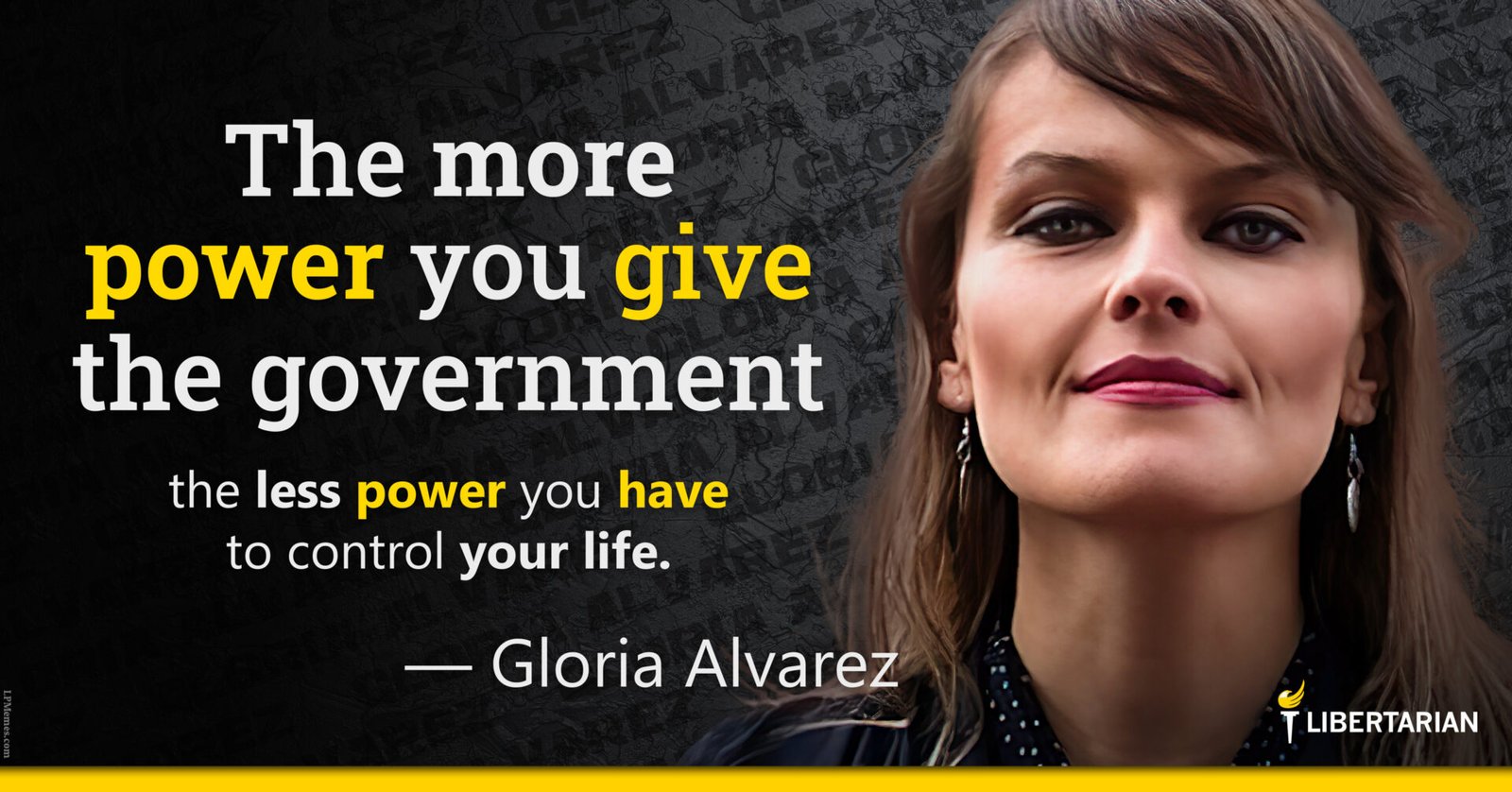
1385: Gloria Alvarez – Government Power

The more power you give the government the less power you have to control your life. —Gloria Alvarez
Normal Quality (1920×1005 275 KB)
The more power you give the government the less power you have to control your life. —Gloria Alvarez
Normal Quality (1920×1372 344 KB)
The more power you give the government the less power you have to control your life. —Gloria Alvarez

The more power you give the government the less power you have to control your life. —Gloria Alvarez

1363: Antony Davies – Spontaneous Order

In Nicaragua where sign language didn’t exist, in 1981, a new school for the deaf opened. Fifty deaf students enrolled during the school’s first year, and a curious thing happened: they developed their own version of sign language. No one taught them this; they simply began assigning signs and gestures to the things in their environment, and slowly a language emerged, complete with verb tenses and the like, to rival any other language. Spontaneous orders are systems that develop organically. They aren’t designed by a coercive authority. They emerge through countless human interactions undertaken over time. —Antony Davies, James R. Harrigan
Normal Quality (3840×2010 122 KB)
In Nicaragua where sign language didn’t exist, in 1981, a new school for the deaf opened. Fifty deaf students enrolled during the school’s first year, and a curious thing happened: they developed their own version of sign language. No one taught them this; they simply began assigning signs and gestures to the things in their environment, and slowly a language emerged, complete with verb tenses and the like, to rival any other language. Spontaneous orders are systems that develop organically. They aren’t designed by a coercive authority. They emerge through countless human interactions undertaken over time. —Antony Davies, James R. Harrigan
Normal Quality (3840×3840 182 KB)
In Nicaragua where sign language didn’t exist, in 1981, a new school for the deaf opened. Fifty deaf students enrolled during the school’s first year, and a curious thing happened: they developed their own version of sign language. No one taught them this; they simply began assigning signs and gestures to the things in their environment, and slowly a language emerged, complete with verb tenses and the like, to rival any other language. Spontaneous orders are systems that develop organically. They aren’t designed by a coercive authority. They emerge through countless human interactions undertaken over time. —Antony Davies, James R. Harrigan

In Nicaragua where sign language didn’t exist, in 1981, a new school for the deaf opened. Fifty deaf students enrolled during the school’s first year, and a curious thing happened: they developed their own version of sign language. No one taught them this; they simply began assigning signs and gestures to the things in their environment, and slowly a language emerged, complete with verb tenses and the like, to rival any other language. Spontaneous orders are systems that develop organically. They aren’t designed by a coercive authority. They emerge through countless human interactions undertaken over time. —Antony Davies, James R. Harrigan

1357: Mary Ruwart – Zimbabwe’s Elephants

In Kenya, the elephant population dropped from 65,000 to 19,000 even though elephant hunting was forbidden. In Zimbabwe, however, natives can claim, or homestead, elephants living on their lands. Natives can legally sell permits to hunt them. Zimbabwe’s elephant population grew from 30,000 to 43,000. People will protect the environment when they own it and profit from it. —Mary J Ruwart
Normal Quality (3840×2010 111 KB)
In Kenya, the elephant population dropped from 65,000 to 19,000 even though elephant hunting was forbidden. In Zimbabwe, however, natives can claim, or homestead, elephants living on their lands. Natives can legally sell permits to hunt them. Zimbabwe’s elephant population grew from 30,000 to 43,000. People will protect the environment when they own it and profit from it. —Mary J Ruwart
Normal Quality (3840×3840 147 KB)
In Kenya, the elephant population dropped from 65,000 to 19,000 even though elephant hunting was forbidden. In Zimbabwe, however, natives can claim, or homestead, elephants living on their lands. Natives can legally sell permits to hunt them. Zimbabwe’s elephant population grew from 30,000 to 43,000. People will protect the environment when they own it and profit from it. —Mary J Ruwart

In Kenya, the elephant population dropped from 65,000 to 19,000 even though elephant hunting was forbidden. In Zimbabwe, however, natives can claim, or homestead, elephants living on their lands. Natives can legally sell permits to hunt them. Zimbabwe’s elephant population grew from 30,000 to 43,000. People will protect the environment when they own it and profit from it. —Mary J Ruwart

1351: Aleksandr Solzhenitsyn – When Should One Resist?

At what exact point, should one resist? When one's belt is taken away? When one is ordered to face into a corner? When one crosses the threshold of one's home?
Normal Quality (3072×3840 243 KB)

At what exact point, should one resist? When one’s belt is taken away? When one is ordered to face into a corner? When one crosses the threshold of one’s home?

How we burned in the camps later, thinking: What would things have been like if every Security operative, when he went out at night to make an arrest, had been uncertain whether he would return alive and had to say good-bye to his family? Or if during periods of mass arrests, as for example in Leningrad, when they arrested a quarter of the entire city, people had not simply sat there in their lairs, paling with terror at every bang of the downstairs door and at every step on the staircase, but had understood they had nothing left to lose and had boldly set up in the downstairs hall an ambush of half a dozen people with axes, hammers, pokers, or whatever else was at hand?

The Organs would very quickly have suffered a shortage of officers and transport and, notwithstanding all of Stalin’s thirst, the cursed machine would have ground to a halt!

If … if … We didn’t love freedom enough. We purely and simply deserved everything that happened afterward.

—Aleksandr Solzhenitsyn, The Gulag Archipelago

1346: Lew Rockwell – Let Us Not Be Mere Spectators

Let us not be mere spectators. With our pens, with our voices, with our contributions to our great cause let us give history a push in the direction of freedom. —Lew Rockwell
Normal Quality (1920×1005 267 KB)
Let us not be mere spectators. With our pens, with our voices, with our contributions to our great cause let us give history a push in the direction of freedom. —Lew Rockwell
Normal Quality (1920×1372 320 KB)
Let us not be mere spectators. With our pens, with our voices, with our contributions to our great cause let us give history a push in the direction of freedom. —Lew Rockwell

Let us not be mere spectators. With our pens, with our voices, with our contributions to our great cause let us give history a push in the direction of freedom. —Lew Rockwell

1343: Scott Horton – It Would Be At the Expense of Our Liberty

Even if somehow waging violent coups and regime change wars across the planet could guarantee freedom for those people, it would necessarily come at the expense of those whose lives and liberty our government is actually sworn to protect: ours. —Scott Horton
Normal Quality (1920×1005 274 KB)
Even if somehow waging violent coups and regime change wars across the planet could guarantee freedom for those people, it would necessarily come at the expense of those whose lives and liberty our government is actually sworn to protect: ours. —Scott Horton
Normal Quality (1920×1372 381 KB)
Even if somehow waging violent coups and regime change wars across the planet could guarantee freedom for those people, it would necessarily come at the expense of those whose lives and liberty our government is actually sworn to protect: ours. —Scott Horton

Even if somehow waging violent coups and regime change wars across the planet could guarantee freedom for those people, it would necessarily come at the expense of those whose lives and liberty our government is actually sworn to protect: ours. —Scott Horton

1342: Hannah Cox – True Feminism

True feminism means the advocacy of women’s rights on the basis of the equality of the sexes. I’m an advocate for men… in every bit as much as I am an advocate for women. —Hannah Cox
Normal Quality (1920×1005 249 KB)
True feminism means the advocacy of women’s rights on the basis of the equality of the sexes. I’m an advocate for men… in every bit as much as I am an advocate for women. —Hannah Cox
Normal Quality (1920×1372 316 KB)
True feminism means the advocacy of women’s rights on the basis of the equality of the sexes. I’m an advocate for men… in every bit as much as I am an advocate for women. —Hannah Cox

True feminism means the advocacy of women’s rights on the basis of the equality of the sexes. I’m an advocate for men… in every bit as much as I am an advocate for women. —Hannah Cox

1338: Karl Hess – Protecting Freedom

If our freedom is so fragile that it must be continuously protected by giving it up, then we are in deep trouble. —Karl Hess
Normal Quality (1920×1005 198 KB)
If our freedom is so fragile that it must be continuously protected by giving it up, then we are in deep trouble. —Karl Hess
Normal Quality (1920×1372 264 KB)
If our freedom is so fragile that it must be continuously protected by giving it up, then we are in deep trouble. —Karl Hess

If our freedom is so fragile that it must be continuously protected by giving it up, then we are in deep trouble. —Karl Hess

1336: Ayn Rand – A Guide to Rights

The rights of one man cannot and must not violate the rights of another. For instance: a man has the right to live, but he has no right to take the life of another. He has the right to be free, but no right to enslave another. The very right upon which he acts defines the same right of another man, and serves as a guide to tell him what he may or may not do. —Ayn Rand
Normal Quality (3840×2010 102 KB)
The rights of one man cannot and must not violate the rights of another. For instance: a man has the right to live, but he has no right to take the life of another. He has the right to be free, but no right to enslave another. The very right upon which he acts defines the same right of another man, and serves as a guide to tell him what he may or may not do. —Ayn Rand
Normal Quality (3840×3840 147 KB)
The rights of one man cannot and must not violate the rights of another. For instance: a man has the right to live, but he has no right to take the life of another. He has the right to be free, but no right to enslave another.
The very right upon which he acts defines the same right of another man, and serves as a guide to tell him what he may or may not do. —Ayn Rand