1395: Lew Rockwell – The Key to Its Survival

If the state loses its grip over your mind, it loses the very key to its survival. —Lew Rockwell
Normal Quality (1920×1005 305 KB)
If the state loses its grip over your mind, it loses the very key to its survival. —Lew Rockwell
Normal Quality (1920×1372 392 KB)
If the state loses its grip over your mind, it loses the very key to its survival. —Lew Rockwell

If the state loses its grip over your mind, it loses the very key to its survival. —Lew Rockwell

1394: Scott Horton – Modern Democracies

Most modern democracies are to some extent dual states. There is the government described in high school civics books, with carefully checked and circumscribed powers — but lurking in the background, there is a far more formidable bureaucratic apparatus, which actually wields the power of the state and cares little for constitutional niceties. —Scott Horton
Normal Quality (1920×1005 247 KB)
Most modern democracies are to some extent dual states. There is the government described in high school civics books, with carefully checked and circumscribed powers — but lurking in the background, there is a far more formidable bureaucratic apparatus, which actually wields the power of the state and cares little for constitutional niceties. —Scott Horton
Normal Quality (1920×1372 333 KB)
Most modern democracies are to some extent dual states. There is the government described in high school civics books, with carefully checked and circumscribed powers — but lurking in the background, there is a far more formidable bureaucratic apparatus, which actually wields the power of the state and cares little for constitutional niceties. —Scott Horton

Most modern democracies are to some extent dual states. There is the government described in high school civics books, with carefully checked and circumscribed powers — but lurking in the background, there is a far more formidable bureaucratic apparatus, which actually wields the power of the state and cares little for constitutional niceties. —Scott Horton

1391: Antony Davies – Not the Poor who Benefit

It is not the poor who benefit the most from “the war on poverty” but the non-poor who benefit from employment in poverty programs. —Antony Davies
Normal Quality (1920×1005 238 KB)
It is not the poor who benefit the most from “the war on poverty” but the non-poor who benefit from employment in poverty programs. —Antony Davies
Normal Quality (1920×1372 325 KB)
It is not the poor who benefit the most from “the war on poverty” but the non-poor who benefit from employment in poverty programs. —Antony Davies

It is not the poor who benefit the most from “the war on poverty” but the non-poor who benefit from employment in poverty programs. —Antony Davies

1390: Dave Smith – That was a Declaration of War

Ron Paul is not only the greatest libertarian ever, he is the greatest living American Hero. When they attacked him, that was a Declaration of War. —Dave Smith
Normal Quality (1920×1005 298 KB)
Ron Paul is not only the greatest libertarian ever, he is the greatest living American Hero. When they attacked him, that was a Declaration of War. —Dave Smith
Normal Quality (1920×1372 408 KB)
Ron Paul is not only the greatest libertarian ever, he is the greatest living American Hero. When they attacked him, that was a Declaration of War. —Dave Smith

Ron Paul is not only the greatest libertarian ever, he is the greatest living American Hero. When they attacked him, that was a Declaration of War. —Dave Smith

1389: Antony Davies – Poverty Bureaucracy

We have developed a poverty industry and a poverty bureaucracy. Both of them seek to perpetuate themselves, and yet the poverty rate remains the same year over year. The war on poverty is not dominated by the people who are poor but by the non-poor who benefit from employment in poverty programs. —Antony Davies
Normal Quality (3840×2010 103 KB)
We have developed a poverty industry and a poverty bureaucracy. Both of them seek to perpetuate themselves, and yet the poverty rate remains the same year over year. The war on poverty is not dominated by the people who are poor but by the non-poor who benefit from employment in poverty programs. —Antony Davies
Normal Quality (3072×3840 280 KB)
We have developed a poverty industry and a poverty bureaucracy. Both of them seek to perpetuate themselves, and yet the poverty rate remains the same year over year. The war on poverty is not dominated by the people who are poor but by the non-poor who benefit from employment in poverty programs. —Antony Davies

We have developed a poverty industry and a poverty bureaucracy. Both of them seek to perpetuate themselves, and yet the poverty rate remains the same year over year. The war on poverty is not dominated by the people who are poor but by the non-poor who benefit from employment in poverty programs. —Antony Davies

1388: Jeff Deist – Personal Secession from the State

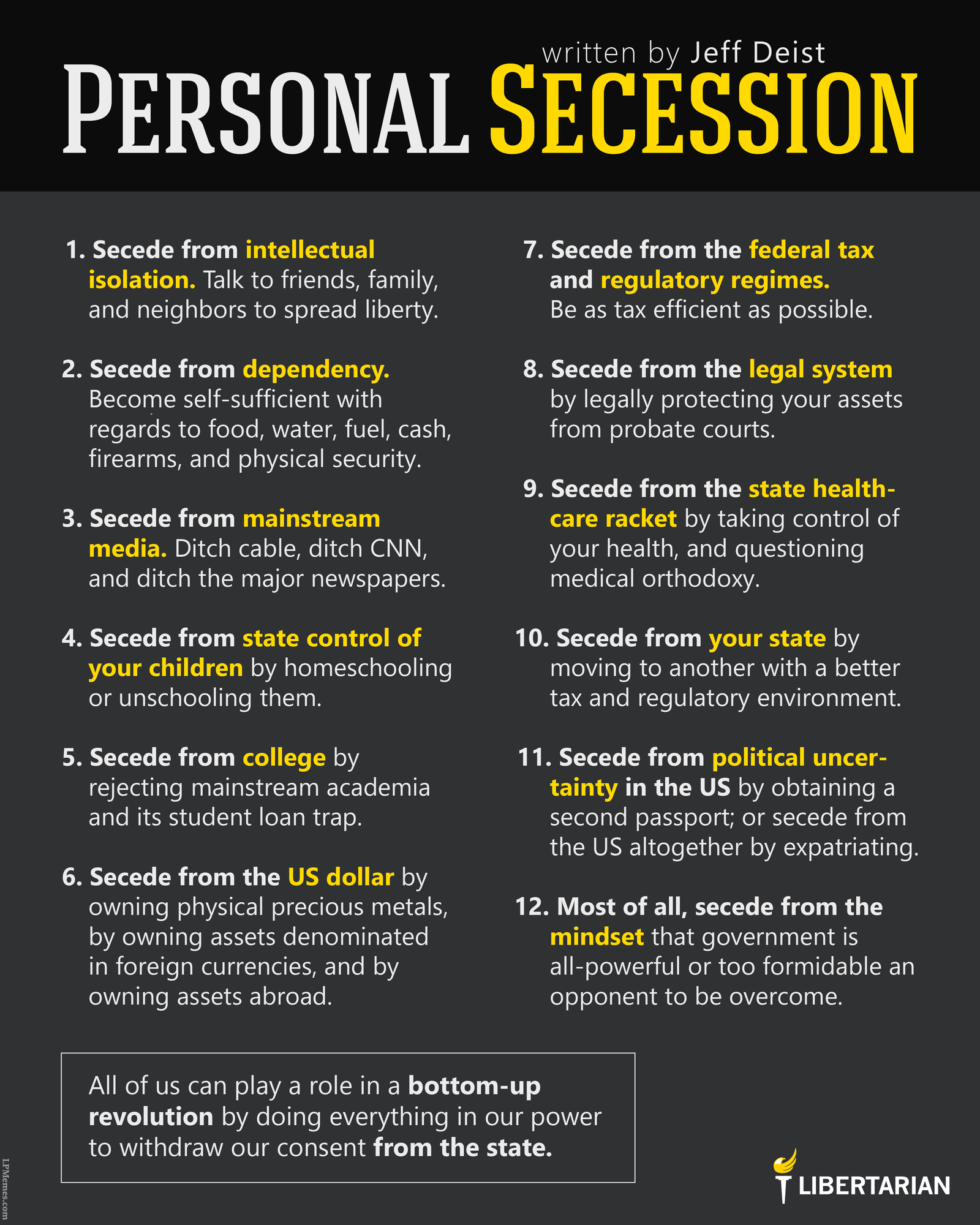
All of us can play a role in a bottom-up revolution by doing everything in our power to withdraw our consent from the state. —Jeff Deist
Normal Quality (3072×3840 220 KB)
All of us can play a role in a bottom-up revolution by doing everything in our power to withdraw our consent from the state. —Jeff Deist
Normal Quality (3072×3840 219 KB)
  1. Secede from intellectual isolation. Talk to friends, family, and neighbors to spread liberty.
  2. Secede from dependency. Become self-sufficient with regards to food, water, fuel, cash, firearms, and physical security.
  3. Secede from mainstream media. Ditch cable, ditch CNN, and ditch the major newspapers.
  4. Secede from state control of your children by homeschooling or unschooling them.
  5. Secede from college by rejecting mainstream academia and its student loan trap.
  6. Secede from the US dollar by owning physical precious metals, by owning assets denominated in foreign currencies, and by owning assets abroad.
  7. Secede from the federal tax and regulatory regimes. Be as tax efficient as possible.
  8. Secede from the legal system by legally protecting your assets from probate courts.
  9. Secede from the state healthcare racket by taking control of your health, and questioning medical orthodoxy.
  10. Secede from your state by moving to another with a better tax and regulatory environment.
  11. Secede from political uncertainly in the US by obtaining a second passport; or secede from the US altogether by expatriating.
  12. Most of all, secede from the mindset that government is all-powerful or too formidable an opponent to be overcome.

All of us can play a role in a bottom-up revolution by doing everything in our power to withdraw our consent from the state. —Jeff Deist

1387: Jeff Deist – Withdrawal from the Federal Leviathan

Imagine what a committed, coordinated libertarian base could achieve in America! Ten percent of the US population, or roughly thirty-two million people, would be an unstoppable force of non-violent withdrawal from the federal leviathan. —Jeff Deist
Normal Quality (1920×1005 324 KB)
Imagine what a committed, coordinated libertarian base could achieve in America! Ten percent of the US population, or roughly thirty-two million people, would be an unstoppable force of non-violent withdrawal from the federal leviathan. —Jeff Deist
Normal Quality (1920×1372 410 KB)
Imagine what a committed, coordinated libertarian base could achieve in America! Ten percent of the US population, or roughly thirty-two million people, would be an unstoppable force of non-violent withdrawal from the federal leviathan. —Jeff Deist

Imagine what a committed, coordinated libertarian base could achieve in America! Ten percent of the US population, or roughly thirty-two million people, would be an unstoppable force of non-violent withdrawal from the federal leviathan. —Jeff Deist

1386: Thomas Sowell – Pay is Not a Reward for Merit

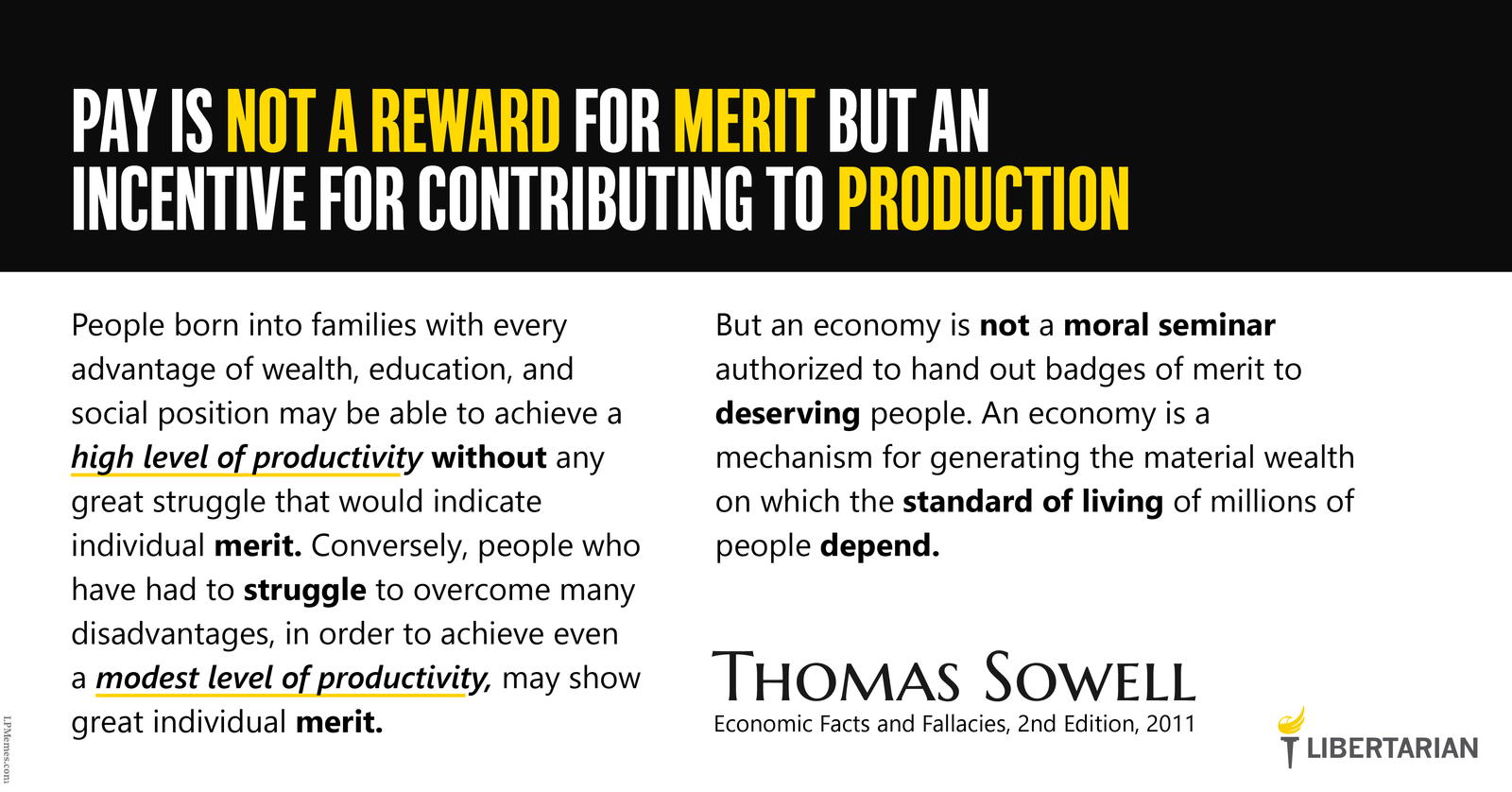
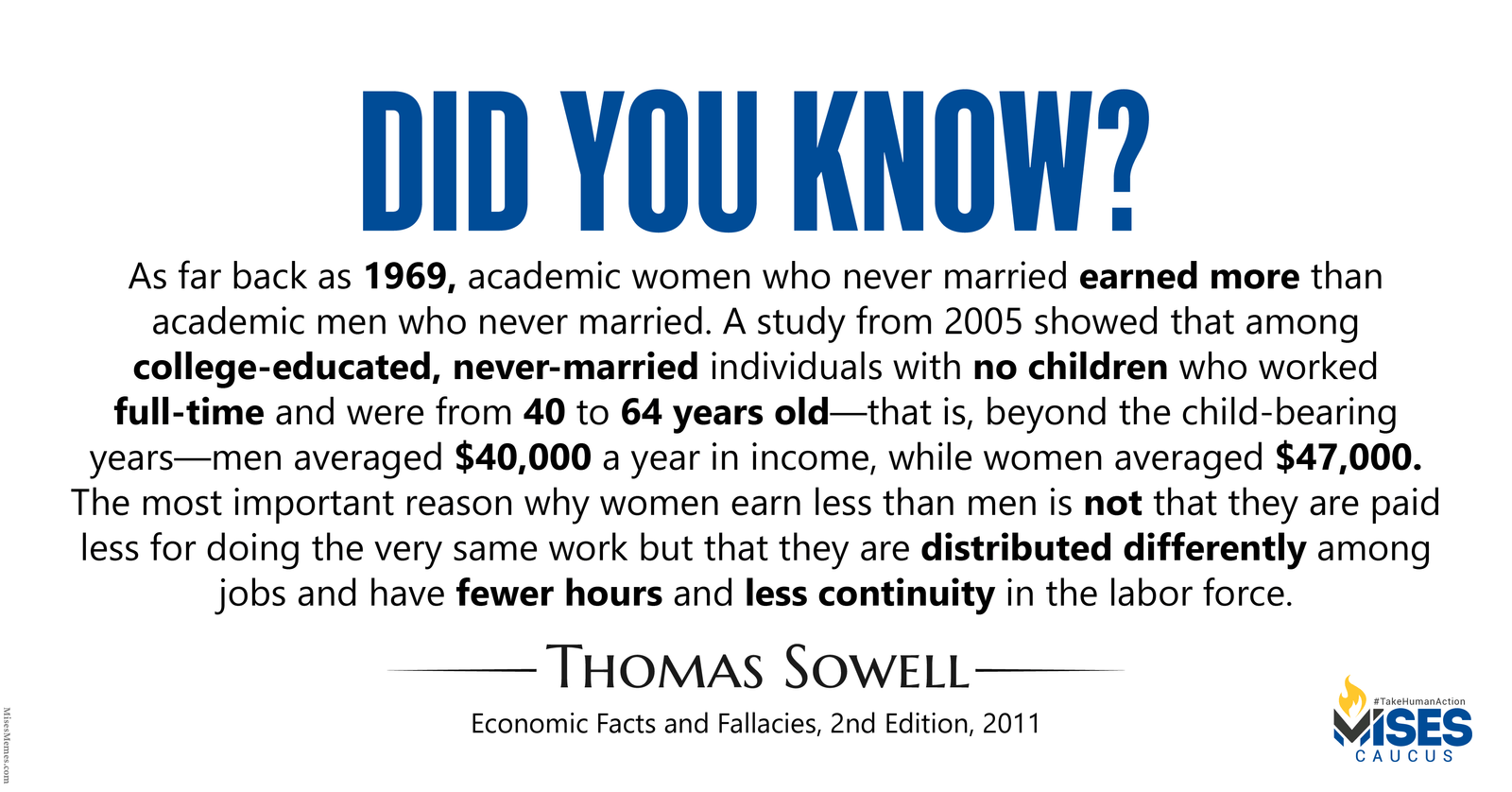
People born into families with every advantage of wealth, education, and social position may be able to achieve a high level of productivity without any great struggle that would indicate individual merit. Conversely, people who have had to struggle to overcome many disadvantages, in order to achieve even a modest level of productivity, may show great individual merit. But an economy is not a moral seminar authorized to hand out badges of merit to deserving people. An economy is a mechanism for generating the material wealth on which the standard of living of millions of people depend. Pay is not a retrospective reward for merit but an incentive for contributing to production. —Thomas Sowell
Normal Quality (3840×2010 129 KB)
People born into families with every advantage of wealth, education, and social position may be able to achieve a high level of productivity without any great struggle that would indicate individual merit. Conversely, people who have had to struggle to overcome many disadvantages, in order to achieve even a modest level of productivity, may show great individual merit. But an economy is not a moral seminar authorized to hand out badges of merit to deserving people. An economy is a mechanism for generating the material wealth on which the standard of living of millions of people depend. Pay is not a retrospective reward for merit but an incentive for contributing to production. —Thomas Sowell
Normal Quality (3073×3840 173 KB)
People born into families with every advantage of wealth, education, and social position may be able to achieve a high level of productivity without any great struggle that would indicate individual merit. Conversely, people who have had to struggle to overcome many disadvantages, in order to achieve even a modest level of productivity, may show great individual merit. But an economy is not a moral seminar authorized to hand out badges of merit to deserving people. An economy is a mechanism for generating the material wealth on which the standard of living of millions of people depend. Pay is not a retrospective reward for merit but an incentive for contributing to production. —Thomas Sowell

People born into families with every advantage of wealth, education, and social position may be able to achieve a high level of productivity without any great struggle that would indicate individual merit. Conversely, people who have had to struggle to overcome many disadvantages, in order to achieve even a modest level of productivity, may show great individual merit. But an economy is not a moral seminar authorized to hand out badges of merit to deserving people. An economy is a mechanism for generating the material wealth on which the standard of living of millions of people depend. Pay is not a retrospective reward for merit but an incentive for contributing to production. —Thomas Sowell
1383: Thomas Sowell – Why Women Earn Less

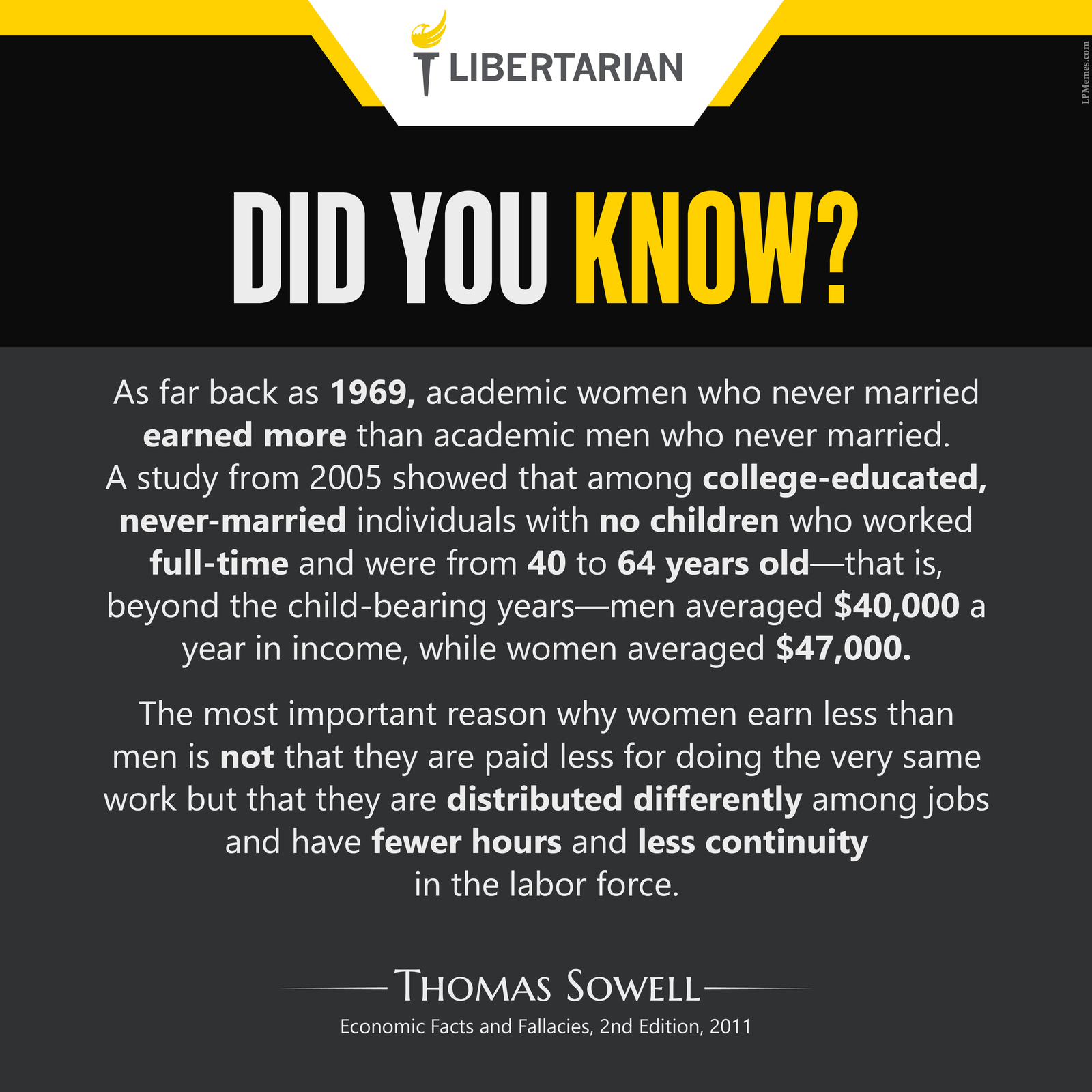
As far back as 1969, academic women who never married earned more than academic men who never married. A study from 2005 showed that among college-educated, never-married individuals with no children who worked full-time and were from 40 to 64 years old—that is, beyond the child-bearing years—men averaged $40,000 a year in income, while women averaged $47,000. The most important reason why women earn less than men is not that they are paid less for doing the very same work but that they are distributed differently among jobs and have fewer hours and less continuity in the labor force. —Thomas Sowell
Normal Quality (3840×2010 126 KB)
As far back as 1969, academic women who never married earned more than academic men who never married. A study from 2005 showed that among college-educated, never-married individuals with no children who worked full-time and were from 40 to 64 years old—that is, beyond the child-bearing years—men averaged $40,000 a year in income, while women averaged $47,000. The most important reason why women earn less than men is not that they are paid less for doing the very same work but that they are distributed differently among jobs and have fewer hours and less continuity in the labor force. —Thomas Sowell
Normal Quality (3840×3840 182 KB)
As far back as 1969, academic women who never married earned more than academic men who never married. A study from 2005 showed that among college-educated, never-married individuals with no children who worked full-time and were from 40 to 64 years old—that is, beyond the child-bearing years—men averaged $40,000 a year in income, while women averaged $47,000. The most important reason why women earn less than men is not that they are paid less for doing the very same work but that they are distributed differently among jobs and have fewer hours and less continuity in the labor force. —Thomas Sowell

As far back as 1969, academic women who never married earned more than academic men who never married. A study from 2005 showed that among college-educated, never-married individuals with no children who worked full-time and were from 40 to 64 years old—that is, beyond the child-bearing years—men averaged $40,000 a year in income, while women averaged $47,000. The most important reason why women earn less than men is not that they are paid less for doing the very same work but that they are distributed differently among jobs and have fewer hours and less continuity in the labor force. —Thomas Sowell

1381: Thomas Sowell – Income Differences Between the Sexes

Although physical strength is no longer as major a factor as it once was, there are still particular industries today where considerable physical strength remains a requirement. —Thomas Sowell
Normal Quality (3072×3840 827 KB)
Although physical strength is no longer as major a factor as it once was, there are still particular industries today where considerable physical strength remains a requirement. —Thomas Sowell
Normal Quality (3072×3840 806 KB)

Although physical strength is no longer as major a factor as it once was, there are still particular industries today where considerable physical strength remains a requirement. While women have been 74% that are classified as “clerical and kindred workers,” they have been:

Less than 5% of transport equipment operatives.

Less than 4% of extraction and maintenance workers.

Less than 3% of construction workers or loggers.

Less than 2% of roofers or masons.

Less than 1% of mechanics and technicians who service heavy vehicles and mobile equipment.

Such occupational distributions have obvious economic implications, since miners earn nearly double the income of office clerks. There is a premium paid for workers doing hazardous work, which often overlaps work requiring physical strength. While men are 54% of the labor force, they are 92% of the job-related deaths.

—Thomas Sowell